19 March 2017

K-Rap: San E


Seoul, or the 120 Days of Sodom, the latest single from San E, is a song that describes the vices associated with fame; alcohol, drugs and sex. It stands in stark contrast to the poppy start of the rapper.
Back in 2010 Korean born, but US raised rapper San E signed a record deal with JYP Entertainment, one of the three biggest record labels in Korea. As you might know the Korean record industry tightly controls every aspect of their artists, from their music to their image. In the case of San E this resulted in his debut single Tasty San, a song that's mostly just comical and meant to reach a large audience. Even though he had some minor success San E's ambition and style however made him decide to leave JYP Entertainment in 2013 and join Brand New Music, a label focusing on hip hop and R&B. This change was accentuated by the release of Rap Circus, a hardcore hip hop song in which he criticizes his previous image. This was quickly followed by his first #1 charting song Story of Someone I Know, a serious but more accessible song.
San E's career took off,  he collaborated with many Korean rappers and singers to create hit after hit, including: Where Did You Sleep (with label mates Verbal Jint and Swings), A Midsummer Night's Sweetness (a sugar sweet duet with singer Raina) and the sexy Body Language.
Everything seemed to go well for the rapper. He released an album in 2015 and was a judge and host on TV shows like 'Show Me The Money' and 'Unpretty Rapstar'. By the end of 2016 however all the fame and money started to go to his head. He became arrogant, depressed and addicted to alcohol and drugs. This process and how he overcame it was conceptualised in his latest EP 'Season of Suffering'. In the song Seoul, or the 120 Days of Sodom he describes the first stage, as mentioned earlier. In Counselor he acknowledges that he has a problem and discusses his condition, playing both the patient and the counsellor. Finally in I Am Me he accepts himself and overcomes his depression.
The 'Season of Suffering' EP is probably one of my all time favourite K-Rap releases. I'm glad to see San E is recovered and can't wait to find out which hits he has in store for 2017.


Other favourite songs: Coach Me, Do It For Fun & What If

For more videos check out San E's official YouTube channel or his playlist at the BRANDNEW MUSIC channel.

19 February 2017

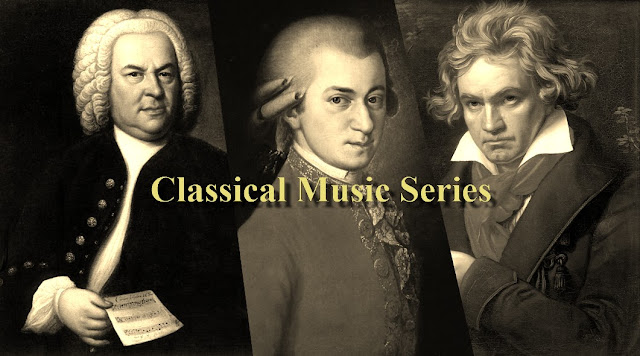
Classical Music Series: Part I - Baroque


This post is part of my Classical Music Series. Read more about it in the introduction.

Baroque is the name given to music composed from 1600 to 1750, a period during which the foundation was laid not only for classical music, but for Western music in general. Composers started making use of basso continuo (also known as figured bass), in which a group of instruments (usually harpsichord, lute and cello) play a fixed bass line on which the chords and melody are improvised. This melody was usually played counterpoint, meaning that two melodies differ in their tempo and direction (for instance one melody going up, while the other goes down) but still sound harmonious or good together. Probably the most influential early baroque composer to implement these techniques was Claudio Monteverdi, who was also responsible for composing one of the earliest still surviving operas: L'Orfeo.

Thanks to Monteverdi baroque music gained attention and became highly popular by the mid-1600's. To be able to satisfy the public demand composers started to downscale the orchestras hereby creating chamber music, which could be played in smaller settings. In Italy the most influential composer at the time was Francesco Cavalli, a student of Monteverdi, who wrote more than 40 operas for small orchestras. Meanwhile in France Jean-Baptiste Lully, royal composer for king Louis XIV, mainly focused on ballets and comedies. Lully was also what we would nowadays call a conductor. He used a large staff to maintain the rhythm. Unfortunately for him this practice literally killed him. During a rendition of Te Deum he hit his foot with the staff, which resulted in gangrene and ultimately his death (who'd have guessed being a conductor was such a dangerous job?!).
Of course the pinnacle of baroque chamber music is the very well known Canon in D Major by Johann Pachelbel. Besides being one of the most played classical pieces during both weddings and funerals its chord scheme also inspired many pop songs over the years including Ralph McTell's Streets of London, Green Day's Basket Case and the more recent Bad Things by Machine Gun Kelly.

At the start of the 18th century baroque music reached its apex, with dozens of composers creating pieces still well known today. If I say for instance "Quattro Stagioni" you say.... Antonio Vivaldi (or granted, pizza if you're hungry). The Four Seasons is Vivaldi's most famous work, and rightfully so. He really manages to capture the feeling of each season in the music. We hear birds in spring, experience a thunderstorm in summer, join the harvest festivities in the autumn and seek shelter for the gruelling snowstorm in winter, the last being my personal favourite. Of course Vivaldi composed many other pieces, mainly concertos and sonatas, most of which have a very bright maybe even playful style.
A lot of Vivaldi's works were transcribed for organ by another great composer: Johann Sebastian Bach. Bach's works generally sound a bit more serious than Vivaldi's. This is not because Bach was German, but rather the fact that he composed many cantatas, masses and passions played in churches which required a more dignified sound. Nevertheless there are plenty of compositions in his 1000+ work oeuvre which sound uplifting (for example his Brandenburg Concertos).
The last composer I'd like to mention is George Frideric Handel, for one because he's one of the first composers I've ever attended a performance from (the Messiah),  but also because he's one of the greatest composers of the Baroque era. Born in Germany in 1685 (same year and country as Bach) Handel moved to Italy in 1703 before ending up in London in 1710. As such even though most of his works have been composed in England clear German and Italian Baroque influences can be heard in his music. Handel's most famous work is without a doubt the Hallelujah Chorus from aforementioned Messiah. Another piece worth listening to is Water Music, composed especially for King George I who requested a concert on the river Thames.

It's a difficult feat to try and summarize 150 years of music in such a short post, but I hope I've managed to peak your interest in Baroque music and maybe even taught you some music history.
If you want to hear more baroque music there are fortunately many ways to do so. YouTube of course is filled with music from all great composers. Some channels specialise in composers or certain instruments. Plenty of playlists can be found on Spotify and last but not least you can go old-school and turn on a classical music radio station. To help you get started I've listed some great works below.

Several Baroque masterpieces:
Arcangelo Corelli                            Concertogrosso, Op. 6, No. 8 in G minor
Henry Purcell                                  Rondeau fromAbdelazer
Georg Philipp Telemann                 Concerto in G major forViola and Strings
Giovanni Battista Pergolesi            Stabat Mater


12 February 2017

Classical music series: Intro


During the past couple of months I have written posts on many different artists and genres. It might be difficult to imagine, but most of these diverse styles find their origins in the same music. Music that is nowadays known as classical music.
When people use the term classical music it is usually an umbrella term used to cover all music composed during a period spanning roughly 400 years. I find it therefore strange to hear people say they do not like classical music. It is like saying you don't like modern music, it just does not make any sense to reject such a wonderful and vast collection of works based on several individual pieces.

Classical music can be differentiated into the eras during which it was made: Baroque, Classical, Romantic and Impressionism to name a few. Each era had its trendsetters, innovators and perfectionists. In this series of posts I will highlight each of these periods and explain what separates one from the other, in the hopes of making you understand what it is exactly that you are listening to.

Part I - Baroque

29 January 2017

Orchestral pop: Hooverphonic


Like many aspects of life music is subject to trends, what's hip, what's cool, what's dope, and changes accordingly. In the 1960's much of the music being played on the radio could be classified as 'orchestral pop'. Composers like Henry Mancini, John Barry and Burt Bacharach wrote hundreds of songs, featuring large symphonic orchestras, which are still well known today. However like most trends come and go, so did the orchestral pop when it was replaced by the funky disco tunes of the 1970's.
Lately I hadn't listened much to orchestral pop, that is until YouTube recommended Hooverphonic to me. Hooverphonic is a Belgian band consisting of the two musicians Alex Callier and Raymond Geerts, supported by several vocalists. Although they've already been active since 1995 I'd never heard of them. Even though their early work features some characteristics of orchestral pop it can't really be classified as such and tends to be a bit more dreamy (for instance 2 Wicky and Eden). Over the years however their sound started to change, gradually getting a more dominating orchestral sound. Mad About You and You Hurt Me are great examples of this.
In 2012 the group collaborated with an orchestra (unfortunately I couldn't find the orchestra's name) and cleverly named the album Hooverphonic with Orchestra. The videos of their concert in Antwerp are the ones that caught my ear. The orchestration of these pieces is beautiful as is Noémie Wolfs' voice which is never overpowered by the orchestra. La Horse, George's Café and Danger Zone all sound like timeless pieces, although this might also be partly due to the black/white filter that the videos use.
In 2015 Wolfs left the group but this didn't stop them from making new songs. Their latest album was released in 2016 but doesn't quite capture that classic orchestral pop sound that I love. However maybe you like their slightly more modern sound: Deep Forest.
Either way orchestral pop is back on my playlist.


Other favourites: One, Jackie Cane and One Two Three

For more videos check out Hooverphonic's VEVO channel.

15 January 2017

J-Pop Rock: SEKAI NO OWARI


Often I discover music through association, for instance by looking at related videos when browsing YouTube. Other times it's because artists I know collaborate with artists I don't know yet. This last example was the case with SEKAI NO OWARI who I discovered while doing research for my blog about Clean Bandit. SEKAI NO OWARI, Japanese for 'End of the World', started out in 2010 as an indie-pop band. They released several songs, most of which are decent sounding like Angel and Devil, but they're not really my cup of tea.
Now try to imagine combining an auto-tuned voice, marching music, a choir and classical piano. Sounds interesting right? Well that's exactly what the group did in 2013 for their song RPG. It's a sound that works well and the group continued to use it in songs like Snow Magic Fantasy and The Flame and Forrest Carnival. However the group didn't sit still and started collaborations outside of Japan to diversify their sound. Dragon Night for instance was produced by Dutch DJ Nicky Romero, while Mr.Heartache was produced by Adam Young of Owl City. Nevertheless I like the band best when they do their own crazy Japanese thing with instrument playing animals and folk-dancing wolves in fairytale surroundings (look at Hey Ho and you'll understand what I mean).
SEKAI NO OWARI has announced that they'll release a new album this year and I for one can't wait until it's released. Meanwhile I'll keep listening to my favourite song of theirs, ANTI-HERO, which features one of the fastest piano-parts I've ever heard in a pop song.


Other favourites: Death Disco (gives an idea of their live-show)
                            Tokyo (collaboration with Owl City) 
                            SOS (amazing piano melody)

8 January 2017

Alon Mor


The first thing you will have noticed when you started reading this post is that the genre is missing from the title. This is not a mistake, but a conscious choice. In preparation of my blogs I usually do some research into how other people classify the artists I discuss. However nobody seems to know how to categorize Alon Mor, a young and very talented producer from Israel. "What am I listening to?" is what I was thinking the first time I listened to Alon's song Jasmine. It starts out with a jazzy/Latin intro, followed by a middle-eastern sounding synth-melody and turns into a future house track. At 1.40 minutes there's a breakdown where the jazzy part returns, followed by ambient music and some classical strings which seamlessly flow into the house part again. I fell in love with the song and it became one of my favourite tracks of 2016.
In the 10 minute long song Demons Alon manages to put in even more genres. The song starts out with a spacey bass line followed by some dark techno but is then followed by middle eastern sounds, classical piano, Spanish guitar, chiptunes and even an church organ.
Two other superb songs are When Silence Kicks In, which is a blend of a fairytale soundtrack and future bass, and Adra De Khal, a very moody, more classical song featuring a concert flute.
You'd think that combining so many different styles, genres and instruments would result in a messy track, but I think that Alon manages to mix everything together in such a way that it becomes a very coherent piece. To get an idea of Alon's versatility check out some more songs below, each one is completely different from the others.


Other favourites:                 Intermission (Dark House
                                            Vega (Glitch-hop)
                                            Scattered Clouds (Electro waltz)
                                            Pablo's Place (Latin)

Check out more songs on Alon Mor's Official YouTube channel.

1 January 2017

Post-grunge: The Pretty Reckless


If you've ever seen the movie 'How the Grinch Stole Christmas' you probably remember the cute little girl with the blond hair. Well that cute little girl, Taylor Momsen, is all grown up now and has become the lead singer of post-grunge band The Pretty Reckless.
The first song I ever heard of the band was Make Me Wanna Die which played during the end credits of the 2010 movie 'Kick-Ass' (which by the way is a very entertaining comedic/action movie). Even though I really liked the song it didn't hook me in immediately. I felt that other songs from the band's debut album, like Miss Nothing and Just Tonight, while still nice felt a bit too generic as well. Several years later, in 2014, however the band released their second album from which the title song Going To Hell clearly is an example of their newer, harder sound. I do however also like the slightly more poppy Messed Up World which has a really nice breakdown at 2.15 minutes in. Last October The Pretty Reckless released their latest album called Who You Selling For with the fast-paced Oh My God and the more classic hard rock sounding Take Me Down. Because of the broader sound now, almost six years after first hearing the band, I can finally say I'm a fan.


Other favourites: My Medicine, Kill Me and Heaven Knows

Check out more videos on the The Pretty Reckless VEVO YouTube channel